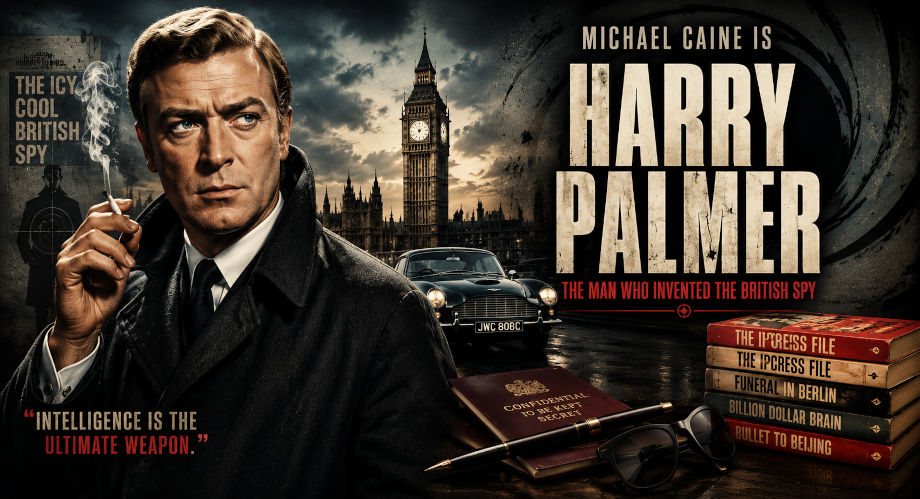
When people think of British spies on screen, James Bond usually comes to mind first. But in the same decade that made 007 a household name, another spy was quietly building his own legend — one who wore glasses instead of a tuxedo, cooked gourmet meals instead of ordering martinis, and answered to his superiors with a shrug rather than a salute. That character was Harry Palmer, and he was brought to life by a young Michael Caine.
Michael Caine
The Making of
'The Ipcress File'
Harry Palmer began life without a name at all. He's the creation of British author Len Deighton, whose 1962 novel The Ipcress File introduced an unnamed working-class intelligence officer as its narrator. When the production team developed the 1965 film adaptation, they needed a name for the previously anonymous protagonist — a rough-edged, petty crook turned spy. The name Harry Palmer was born, and it stuck for every subsequent adaptation of Deighton's novels.
The man behind the deal was producer Harry Saltzman, who by then was already one half of the team producing the James Bond films alongside Albert R. Broccoli. Saltzman decided to adapt The Ipcress File for the screen in the hope of launching a second spy movie franchise that could run alongside the Bond series. He deliberately went the opposite direction stylistically: unlike the Bond films, The Ipcress File was designed to have a somewhat different, naturalistic style, with hints of the kitchen-sink school of British drama. Fittingly, though, Saltzman still brought in Bond talent behind the camera, including production designer Ken Adam, editor Peter Hunt, and composer John Barry.
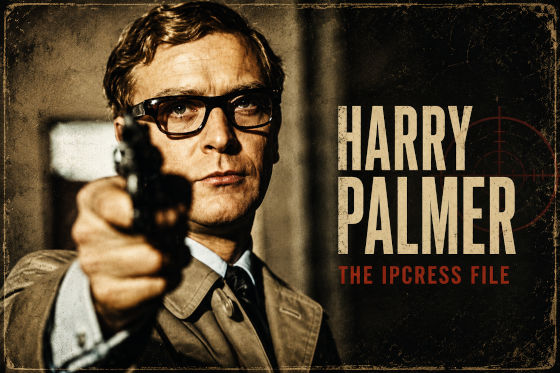
Where Bond was a suave, aristocratic naval commander with a license to kill, Palmer was something altogether more relatable. In the film version, Harry Palmer is a British Army sergeant forcibly drafted into the security services to work off a prison sentence for black marketeering, first for Army Intelligence and then the Foreign Office. He's insubordinate, sarcastic, and about as far from a gentleman spy as you can get — a working-class antihero navigating a world of upper-crust spymasters who barely trust him and rarely respect him.
His look became just as iconic as his attitude: heavy horn-rimmed glasses and a flat, dry Cockney wit that had nothing to do with gadgets or glamour. That combination proved influential well beyond the 1960s — Palmer's thick glasses, taste for women, and disregard for authority were cited by Mike Myers as an influence on Austin Powers, a spy spoof that, in a nice bit of circularity, Caine himself later joined. Caine went on to play Nigel Powers, Austin's father, in Austin Powers in Goldmember (2002) — a role that was itself a loving spoof of Palmer.
Before there was a film, or even a name, there was Len Deighton — and Palmer's entire sensibility comes directly from him. Deighton was the son of a chauffeur and a private cook for a wealthy London family, and before turning to writing he worked as a military photographer, a pastry chef, an airline cabin steward, and a commercial artist, eventually deciding on a whim to attempt a spy novel after years spent studying the genre during work layovers between Cairo and Hong Kong. That itinerant, hands-on background shows up everywhere in the prose — Deighton trained at the Royal College of Art and worked as an illustrator, and his visual precision shows: scenes are composed with a filmmaker's eye, full of specific details that make the world feel lived-in rather than invented.
The result, published in 1962, was something genre readers hadn't quite seen before. The IPCRESS File is narrated by an unnamed, working-class intelligence officer who is more likely to be found shopping for groceries than sipping martinis, sardonic and observant and perpetually unimpressed by his superiors — an effect that's both comic and unsettling, since beneath the dry humor lies a genuine paranoia about who can be trusted and what the intelligence services are actually willing to do. Deighton himself later insisted the resemblance to Bond was pure coincidence of timing rather than a deliberate reaction: "I had never read a James Bond book," he said in a 1997 BBC interview, noting that his novel happened to be published the same month Dr. No hit cinemas. Whatever the intent, the contrast landed exactly as it would later land on screen — Deighton recalled a friend telling him, "You're a blunt instrument that the critics have used to smash Ian Fleming over the head."
That cynicism toward institutions wasn't incidental to the story — Deighton's spy fiction is marked by elliptical narratives short on explanatory detail, reflecting the actual mysteries of espionage, but filled with unforgettable moles, traitors, and characters who double- and triple-cross one another. And unlike his more famous predecessors, Deighton's protagonist moved nowhere near the upper echelons of the intelligence world that populated the novels of Ian Fleming, John le Carré, or Graham Greene — he was a working-class man who got by on insolence and wisecracks. Across the eight novels Deighton eventually wrote featuring this same protagonist, the character remained largely unnamed and shifted in small ways from book to book, but the throughline never changed: an ironic contrast between an obsessive attention to the technical mechanics of spying and the characters' near-total inability to determine the truth of any given situation, or even communicate clearly with each other. Running underneath all of it was a cynical, class-conscious view of British politics and the establishment, shaped by the real espionage scandals that rocked Britain through the 1950s and 60s.
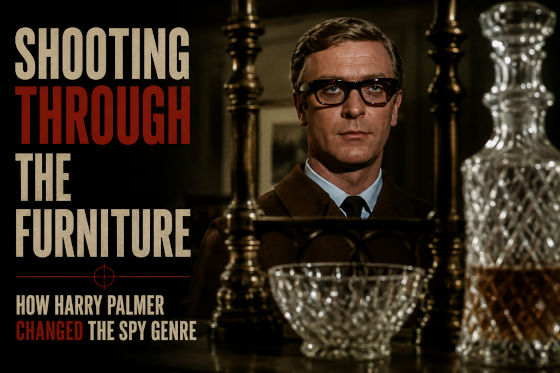
Palmer's other defining feature — the glasses — very nearly didn't make it to screen at all, and the reason is a nice piece of trivia in its own right. Both Deighton and Caine wore heavy, thick-framed glasses themselves, and just as the book's Harry Palmer wore them too, the author and his lead actor lobbied producer Harry Saltzman to let Caine wear the same look on camera. Saltzman initially resisted the idea outright. He was eventually overruled — and the glasses Caine did wear became arguably the single most recognizable visual element of the entire character, copied and referenced for decades afterward, right down to Austin Powers.
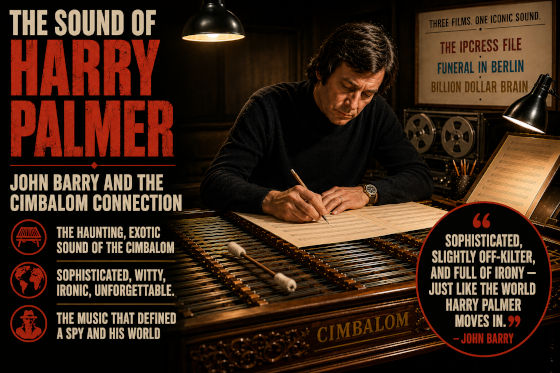
If the glasses gave Palmer his look, it was composer John Barry who gave him his sound — and the score is inseparable from why the character feels so distinct from Bond even in the abstract. Barry, already deep into scoring the 007 films at the time, deliberately set out to write something that pulled in the opposite direction. He sought a unique sound specific to the story and its characters, one that would distinguish the humdrum world of real-life British spies from the larger-than-life fantasy of James Bond.
His solution was an unusual instrumental choice for a mainstream British thriller. For the film, Barry decided to play the main theme on the cimbalom, a type of Hungarian hammered dulcimer, whose spiky, abrasive, twangy sound emphasizes the loneliness and forlorn nature of the main character. The instrument itself is a distinctive piece of kit — a trapezoidal box strung with metal strings that are struck with beaters, an Eastern European instrument more commonly associated with gypsy music than with British espionage cinema. That unlikely pairing is exactly what made it work: paired with wonderful parts for flute and horns, the melody moves through a slow shuffle that builds toward a deep, sinister ending, evoking Cold War unease rather than glamorous adventure.
The resulting main theme, titled "A Man Alone," became one of Barry's most celebrated pieces of film music, and the title alone tells you everything about how it was meant to characterize Palmer. The cimbalom's twangy, Danubian sound gave The Ipcress File its characteristic identity, most notably in that main theme — deployed to sum up the tension of an agent working in the field who can't be sure who to trust, and who knows his next move could be his last. Barry's own peers recognized what the score achieved for the film as a whole; one tribute after the composer's death quoted a colleague's assessment plainly: "If you want to see an example of what music does for a movie, go and see The IPCRESS File. Then you'll understand what John Barry's all about."
The Ipcress File arrived in the middle of an extraordinary run for Barry, sandwiched between some of the most significant work of his career. During that same decade he composed memorable scores for Zulu and Midnight Cowboy, while also winning his first Oscars for Born Free and The Lion in Winter — and Ipcress stands alongside those as one of the clearest demonstrations of his gift for finding a single instrumental voice that could define an entire film's emotional register. He liked the cimbalom's effect enough to return to it later, most notably for the theme tunes of the television series Vendetta and The Persuaders!
Curiously, audiences at the time barely heard most of what Barry actually wrote. Barry composed nearly 50 minutes of original music for the film, but only around 17 minutes made it onto the soundtrack album he assembled for Decca around the time of the premiere — the rest, edited, rearranged, and interspersed with jazz variations on the main theme, left roughly 35 minutes of the score unreleased for decades. The album that did emerge leaned heavily into those jazzy reworkings of "A Man Alone," featuring the cimbalom alongside brilliant trumpet and piano playing — a listening experience quite different from, and considerably jazzier than, the way the cues actually function within the film itself. It wasn't until decades later that soundtrack specialists went back and reconstructed the fuller score: a complete recording project eventually assembled the previously unreleased material, performed by the City of Prague Philharmonic Orchestra, conducted by Adam Klemens, giving listeners for the first time a chance to hear the cimbalom-driven Cold War atmosphere Barry built for Palmer's world in something closer to its original, unedited form.
If the cimbalom gave Palmer's world its sound, cinematographer Otto Heller and director Furie gave it its equally distinctive look — one built almost entirely around obstruction. Rather than shoot scenes cleanly, the two made a decision that still gets cited as a landmark of visual storytelling decades later: Furie and Czech cinematographer Otto Heller redefined their visual vocabulary by deciding to shoot as much of the film as possible through obstructions or foreground objects, doing so across roughly 100 separate shots.
That choice inverted the normal logic of composition. In the past, a large foreground object in a shot usually signaled that it was the focus of the scene; Furie and Heller instead made every foreground object into a framing device that actively composed the shot — a lamp, a doorway, a phone box, forcing the audience to peer past or around something to see the actual scene. When Heller's shots weren't extremely high-angled, low-angled, or tilted, they were framed through every kind of foreground obstruction imaginable — lamps, doors, telephones — with as much as 75 percent of the frame sometimes blotted out, forcing the viewer to look over a shoulder or under an armpit to see a character at all. The technique wasn't decoration; it was doing narrative work. It was used both to reveal specific story elements on screen and to visually express the claustrophobic, unsettling tone of the film — and rather than reading as a gimmick, repeated across the full runtime, it became a genuine creative tool.
The format itself helped make the trick possible. Furie and Heller took advantage of the Techniscope format to "iris in" on selected parts of a frame without enlarging them in close-up, an approach that meant the sheer variety of shots never let the viewer switch off in boredom — there was always something happening, underscoring the film's central mystery and mind-games, so that the audience effectively experienced the story as a half-glimpsed act of surveillance itself. Film historian Duncan Petrie later summarized the effect similarly, noting that the film "abounds with forced angles — particularly extreme low shots — and Dutch angles," with objects frequently obscuring the audience's view of both characters and action, right down to an entire fight sequence shot without the camera ever leaving a telephone box.
Not everyone was a fan at the time. Furie's style drew open scorn from at least one legendary contemporary — Billy Wilder reportedly lambasted the young director's eccentric camera style, joking that Furie couldn't shoot a scene without framing it through a fireplace or the back of a refrigerator — a jab a later retrospective conceded was "coarse but accurate," even while arguing Wilder had missed the technique's actual purpose. Whatever critics of the day made of it, the industry's own judgment was clear: the film won the BAFTA for Best British Film of 1965, as well as BAFTAs for Best Cinematography, Best Art Direction, and Best British Actor. It was, notably, the second time in a row Heller and Caine had worked together to acclaim — Heller had photographed Alfie the same year, the film that made Caine a star in his own right, before following it immediately with Ipcress.
That BAFTA sweep is also where the earlier Saltzman–Furie tension resurfaces with a nastier edge. Contemporary accounts suggest the friction over the finished film's style wasn't just an ego clash but something closer to genuine dislike: Saltzman reportedly hated how Furie had shot the film, and was reportedly so enraged that he accepted the Best Film BAFTA himself and never shared it with his director. It's a strange footnote to a triumph — a producer publicly furious about the very stylistic choices that helped the film sweep its category at the industry's own awards.
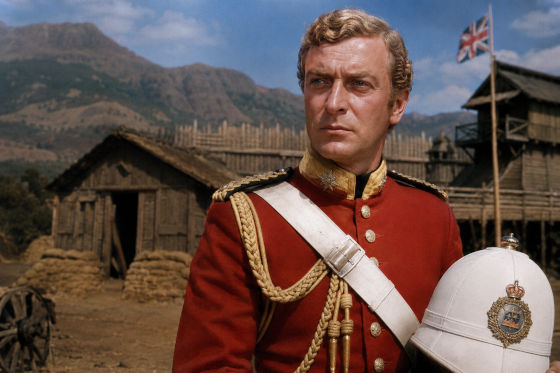
Caine's casting as Palmer looks inevitable in hindsight, but it came at the end of a genuinely long struggle. Born Maurice Micklewhite, Caine was an "overnight success" that had actually been over fifteen years in the making, a then-31-year-old actor who had struggled to make his mark before finally landing his breakout role. The role that changed everything wasn't Palmer at all, but a very different part the year before: an aristocratic army officer in Zulu (1964). The casting itself was almost accidental. Caine's first indirect brush with the film industry had been working as a filing clerk and messenger for a film producer, and it was an actor friend, Stanley Baker, who urged Caine to meet Zulu's American director, Cy Endfield. The part Caine originally wanted was already taken — Endfield had already cast one of Caine's own pals as the Cockney private he'd hoped to play. As Caine himself later told the BBC, that rejection became the opening: "When I was walking out, I got right to the door and he said, 'You don't look like a Cockney to me... You look like one of those upper-crust officers. Can you do that?'" Caine said he could, and walked away with the role of Lieutenant Gonville Bromhead instead — his breakthrough, playing precisely the kind of upper-class Englishman he would spend the rest of the decade defining himself against.
That's what makes the leap to Palmer, just a year later, so striking: Caine came into the public eye as an upper-class British army officer in Zulu, which makes it paradoxical that he then became best known for using his own regional accent rather than the Received Pronunciation that had until then been considered proper for film actors — his working-class Cockney stood out to British and American audiences alike, much as The Beatles' Liverpudlian accents had. Caine followed Zulu immediately with the lead in The Ipcress File, reuniting with his Zulu co-star Nigel Green, who played Major Dalby. Producer Harry Saltzman's ambitions for the casting were explicit about what he wanted Palmer to represent — Saltzman wanted Palmer to be the "antithesis of James Bond," an ordinary bloke with a deliberately boring name, living in a bedsit in Notting Hill and buying his own groceries — details that, at the time, amounted to an astonishing reversal of the usual screen-spy gender dynamics, given the script even had Palmer cooking dinner to seduce a woman rather than the other way around.
That cooking scene produced one of the most charming pieces of trivia connected to the whole production. Palmer's culinary confidence was meant to look effortless on screen, but Caine couldn't actually pull off the signature trick the script called for: "I had to make her an omelette using the macho trick of breaking two eggs simultaneously and with one hand — very spectacular. I couldn't do it though, as it's very tricky. So we had to use the hands of Len Deighton, who could," Caine later admitted — meaning the novelist himself literally stood in, hands doubling for Caine's, to pull off his own character's signature bit of kitchen bravado.
The gamble paid off immediately. On release, the film was hailed as showing a different side of swinging-sixties Britain, and it won a BAFTA. Even so, it was the very next year's film that made Caine a true international star: his real breakthrough came with the title role in Alfie (1966), which earned him his first Academy Award nomination for Best Actor. The financial jump from a jobbing actor's wages to sudden stardom hit Caine hard, in ways he later found funny to recall. "With my new-found wealth I went completely mad, buying masses of shirts, sheets, towels, socks, tubes of toothpaste, bottles of shampoo, and a complete collection of aftershave lotions until it was almost impossible to move in my bathroom," he said, reflecting on earning what was, for someone of his background, an almost unbelievable sum at the time.
From there, Caine's career only accelerated. He went on to headline a run of acclaimed films through the late 1960s and into the 1970s, including Funeral in Berlin, Get Carter, and The Italian Job, becoming the defining face of a new kind of leading man — the working-class bloke with glasses and a down-home accent who had, until Palmer came along, rarely been allowed to be the hero at all. Across a career that would eventually span over 130 films, Caine went on to be nominated for an Academy Award in five consecutive decades, winning twice for Best Supporting Actor — for Hannah and Her Sisters (1986) and The Cider House Rules (1999). It's a career built on an extraordinary range, but it's Harry Palmer, the ordinary bloke Saltzman built specifically to be nothing like James Bond, that still marks the moment the range began.
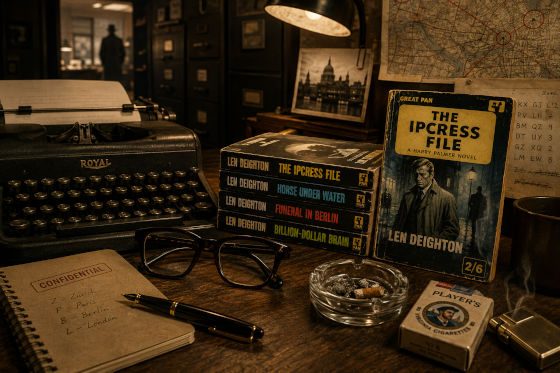
The films only ever adapted a slice of Deighton's actual body of work, and the books themselves reward a closer look — not least because they're considerably more layered than their screen versions let on. Deighton's own upbringing gave him a lifelong, wry fascination with class that runs through every one of them. He liked to describe his childhood in a memorable, self-deprecating way: Deighton loved to say he "grew up in a house with 15 servants," adding that his parents were two of them — his father the chauffeur and mechanic for a museum curator, his mother a part-time cook, the family living in the mews behind the grand house rather than in it. That joke is essentially the thesis of the entire Palmer series compressed into one line.
Funeral in Berlin (1964), the third novel and the second to reach the screen, sends the nameless spy to East Berlin to facilitate the defection of an East German scientist, working uneasily alongside Russian security chief Colonel Stok and a British Home Office official named Hallam, through an elaborate scheme to smuggle the scientist out. The book was a genuine commercial hit in its own right — it spent time on the New York Times bestseller list — and fans of the series often rate it above the more famous Ipcress File for being a cleaner, more confident piece of plotting. One longtime reader of the whole run put it bluntly: of all the books in the series, Funeral in Berlin was the one where the plot clicked into place most satisfyingly, after finding The Ipcress File itself genuinely confusing on a first read.
Billion-Dollar Brain (1966), the fourth novel, pushes furthest from anything resembling realistic Cold War tradecraft into something closer to Cold War paranoia crossed with pulp science fiction. The unnamed protagonist is dispatched to Helsinki by his boss Dawlish to suppress a newspaper article that could embarrass the UK government, only to find the journalist already murdered. He's drawn in by a young woman, Signe Laine, connected to his old American friend Harvey Newbegin, who in turn tries to recruit him into a private intelligence network run by "the Brain" — a billion-dollar supercomputer owned by an eccentric Texan billionaire, General Midwinter. It's easy to see, reading the premise, exactly why Ken Russell's wilder directorial instincts were such a natural fit for the film version — the book was already tilting toward the outlandish well before Russell got hold of it.
Running underneath all of these is a structural signature that Deighton fans come to recognize quickly: a deliberately intricate plot full of dead ends, which is as much a stylistic choice as a narrative one — Deighton wanted his novels to feel like the genuine confusion of intelligence work rather than a tidy detective puzzle. Series regulars recur across the books to reinforce that sense of a lived-in world rather than one-off capers: General Stok, the Russian officer introduced in Funeral in Berlin, pops up again in Billion Dollar Brain, initially hinting that he too might want to defect.
There's an unexpectedly domestic thread running through the whole series, too, one the films only lightly gestured at with that omelette scene. Harry Palmer, in the novels, is genuinely quite the cook — an interest Deighton gave him that adds an unusual, almost cozy dimension to otherwise cold and cynical spy plots. That wasn't incidental to Deighton's own life, either — Deighton had previously published a cartoon cookbook, a collection of illustrated cooking strips he'd originally drawn for a London newspaper before he ever started writing novels, which he put out once the Palmer books had made him famous. Palmer's love of gourmet food, in other words, wasn't a screenwriter's flourish; it came straight from the author's own pre-novelist career as, among other things, a trained pastry chef.
Deighton kept writing spy fiction with working-class protagonists for decades after Palmer, and critics have long drawn a direct line between the two eras of his career. Critic George Grella considered Deighton "the angry young man of the espionage novel," noting that both the unnamed IPCRESS-era protagonist and Bernard Samson, the hero of Deighton's later nine-novel series, share the same basic DNA: working-class, cynical, and streetwise, set against upper-class and often ineffective senior figures within the intelligence services — heroes built, from the very start, in conscious opposition to Ian Fleming's Eton- and Fettes-educated, smoothly upper-class James Bond. Palmer, in that sense, wasn't a one-off gimmick to counter-program Bond commercially. He was the first expression of a worldview Deighton would keep returning to for the rest of his writing life.
The last of the Bond veterans Saltzman brought over deserves his own closer look, because Ken Adam's contribution to Palmer's world was, in its own way, as radical a departure as Furie and Heller's camerawork. By 1965, Adam was already becoming the most celebrated production designer in British cinema, having built some of the most extravagant sets ever put on screen for the Bond films, and having just designed the legendary War Room for Kubrick's Dr. Strangelove. Ipcress asked him to do something close to the opposite of all of that.
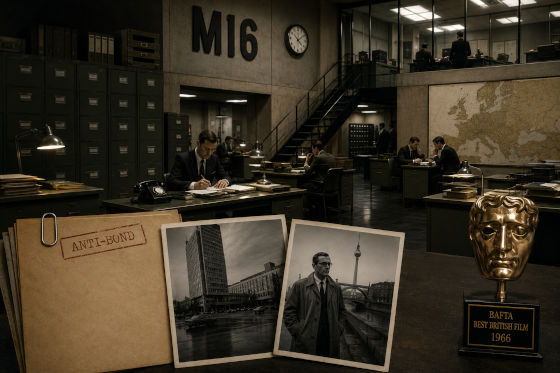
Adam recalled the assignment's real challenge decades later in an interview: producer Harry Saltzman initially thought The Ipcress File was going to be an economical James Bond film, but the production team had already privately decided it would be the anti-Bond instead — a distinction Adam had to design his way into on a low budget, using almost entirely real locations rather than built sets. The task that mattered most to him was the office of the spy chief overseeing Palmer's world. Adam had to design the MI6 chief's office, and he deliberately wanted it to be very minimalistic and uninviting, to reflect the character of the man sitting behind the desk. Where Bond's superiors operated out of grand, gadget-filled rooms, Palmer's bosses worked somewhere deliberately cold and institutional — bureaucracy rendered as physical space.
Adam later spoke fondly, if a little ruefully, about how the film's unglamorous approach paid off against the odds. "It had a look to it, considering that it was all shot on location," he recalled, praising the team he was working with — cinematographer Otto Heller, a strong camera operator, and director Sidney Furie, working with a Michael Caine who was only making his second picture and was, in Adam's words, "brilliant in it." The result surprised even the people who'd made it: Adam recalled that producers Cubby Broccoli and Harry Saltzman had placed a bet on the outcome at that year's BAFTAs, and, to everyone's surprise, Adam won for The Ipcress File rather than for the Bond film he'd also been up against — a result Broccoli reportedly didn't speak to him about for weeks afterward.
That BAFTA sat alongside a career's worth of major honors. Adam ultimately won two BAFTAs (for Dr. Strangelove and The Ipcress File) and two Academy Awards (for Barry Lyndon and The Madness of King George), received the Art Directors Guild's Lifetime Achievement Award in 2002, and in 2003 became the only production designer ever knighted by the Queen. Given that resume — the Bond films' futuristic extravagance, Strangelove's War Room, an actual knighthood for set design — it says something about how well the Ipcress assignment suited him that Adam kept returning to Palmer's world afterward, going on to design its 1966 sequel, Funeral in Berlin, immediately after the original. The instinct to strip everything down, rather than build it up, turned out to be just as much his signature as the gadget-filled spectacle he was already famous for.
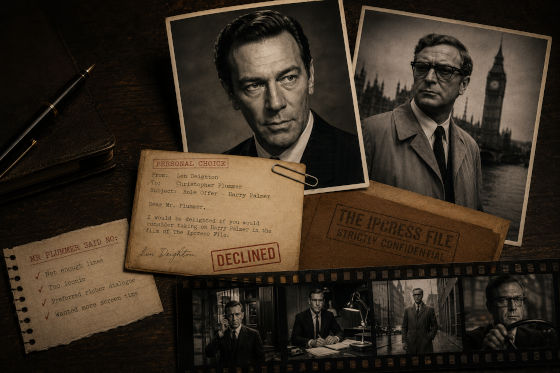
It's strange to imagine now, but Caine wasn't the first choice for the role that would define his early career. According to production accounts, that honor initially went to Christopher Plummer, who turned the offer down to star in The Sound of Music instead. It's one of those quirks of film history where a scheduling decision on one classic reshaped the fate of another — Plummer went off to sing "Edelweiss" in the Alps, and Caine, then a relative unknown, got the part that would launch him into international stardom.
The film marked Caine's screen debut in the role, and the screenplay, credited to Bill Canaway and James Doran, centered on Palmer's investigation into the kidnapping and brainwashing of prominent British scientists amid bureaucratic infighting inside the intelligence community. It was shot in Techniscope and ran 109 minutes, produced by Harry Saltzman through his Steven S.A. production company. The budget was a modest $750,000, and the film premiered in the UK on 18 March 1965.
Saltzman's ambitions for the project were explicit from the start. Bond co-producer Harry Saltzman aimed to establish Harry Palmer as the anti-007, and to help him do it he hired composer John Barry, editor Peter Hunt, and production designer Ken Adam — all key players on the Bond series. The contrast in setting was just as deliberate: while Bond gets to gad about the Caribbean, Palmer, a working-class culture nut, remains stuck in shabby, dimly-lit London.
Behind the camera, director Sidney J. Furie brought a visual boldness that became one of the film's most talked-about features. Furie, working with veteran cinematographer Otto Heller, filled the wide screen with slabs of colour and frequently cramped faces into odd corners of an angular frame — an approach that was unusual for a mainstream thriller at the time and gave the film a distinctly off-kilter, subjective feel, as though the audience was watching Palmer's world through a slightly warped lens. One retrospective on the film's direction singled out a particular sequence — a prisoner exchange and payoff staged in an underground parking lot, with machine-gun-toting guards moving in ritualized, symmetrical patterns — as an example of visual ingenuity that went on to influence the visual grammar of countless later thrillers.
Not everything behind the scenes was harmonious, though. Furie and Saltzman reportedly clashed badly over the course of production, to the point that Furie later claimed the producer excluded him from the film's celebration party at Cannes, and even took his Best Picture BAFTA award for himself. Whatever the tension, the finished film's reputation was never in doubt: The Ipcress File went on to win the BAFTA for Best British Film of 1965, and it received particularly high praise in England, cementing Caine's arrival as a major screen talent.
Critics at the time understood exactly what the film was doing culturally, not just cinematically. Writing in Sight & Sound in 1965, critic Geoffrey Nowell-Smith noted that the film represented a genuine shift in whose stories British cinema was willing to tell heroically — "for the first time in a British film, heroism is no longer the prerogative of a tight-lipped aristocracy imbued with the public-school ethos." Palmer wasn't a gentleman playing at being tough. He was a jumped-up sergeant with a criminal record, and the film insisted that was worth taking seriously.
Palmer, a British military intelligence agent, is reassigned by his superior Ross (Guy Doleman) to a unit headed by Major Dalby (Nigel Green), and tasked with investigating the disappearance of a scientist — the latest in a string of important researchers who vanish and later reappear stripped of their expertise. The trail leads Palmer to a mysterious, unexplained clue known only as IPCRESS, and eventually to his own kidnapping and brainwashing at the hands of the very people he's chasing. Palmer resists and appears to fall under his captors' control, primed to respond to a trigger phrase intended to make him act on command; he suspects Ross of being a double agent, though he has his doubts about Dalby too. When Palmer finally confronts both men at gunpoint, each tries to convince him the other is the traitor — but Palmer recognizes that it's Dalby using the trigger phrase to manipulate him into killing Ross, and shoots Dalby instead as the truth becomes clear.
It's a plot that trades Bond's spectacle for something closer to creeping paranoia — bureaucratic backstabbing, brainwashing, and the sense that nobody in the intelligence services, including your own boss, can be fully trusted. That tone, as much as Palmer's glasses and grocery list, is what separated the franchise from Bond in the eyes of contemporary audiences.
Caine played Palmer across three films adapted directly from Deighton's novels, released in rapid succession as Saltzman tried to build the character into a genuine ongoing series.
The Ipcress File (1965) introduced the character and remains the most celebrated of the three, for all the reasons above — Furie's visual style, Caine's star-making performance, and a plot that treated its spy as a pawn rather than a hero with all the answers.
Funeral in Berlin (1966) followed, sending Palmer into Cold War intrigue in a divided Berlin, trading the claustrophobic London settings of the first film for the tension of the Iron Curtain.
Billion Dollar Brain (1967) closed out the original run with a considerably wilder, more surreal tone — unsurprising, perhaps, given it was directed by Ken Russell, a filmmaker far better known for his flamboyant, provocative style than for grounded spy thrillers. The film pit Palmer against an unhinged, anti-Communist Texas billionaire plotting to overthrow the Soviet government, a plot so outlandish it practically dared audiences to remember this was the same franchise that had started out so gritty and restrained.
Together, the three films establish a clear arc — from paranoid realism, to Cold War tension, to nearly cartoonish excess — even as Caine's performance stayed remarkably consistent throughout: dry, unimpressed, and never quite convinced any of it was worth the trouble.
Palmer's story didn't end in 1967. Deighton continued writing novels featuring the character (still unnamed in print, though universally associated with "Harry Palmer" thanks to the films), and not every novel made it to the screen — Horse Under Water, An Expensive Place to Die, and Yesterday's Spy were never adapted. One later novel, Spy Story, was filmed in 1976 with the character renamed Patrick Armstrong rather than Palmer.
Caine himself returned to the role decades later for two television films, Bullet to Beijing (1995) and Midnight in Saint Petersburg (1996) — post-Cold War outings that, while not based on Deighton novels, brought the character back to a changed geopolitical landscape.
More recently, the character got a full reintroduction for a new generation. A 2022 television adaptation of The Ipcress File went back to Deighton's source material, adapted by John Hodge and directed by James Watkins, with Joe Cole taking on the role of Palmer — glasses and all — in a six-part series that paid explicit homage to Caine's original performance.
That homage was deliberate right down to individual shots. The series opens with a nod straight to the 1965 film — a blurry point-of-view shot of Palmer waking up in bed, resolved only when he puts on his glasses — a camera trick fans of the original would recognize instantly. Cole himself was candid about the challenge of stepping into a role so completely defined by one actor. Speaking to press ahead of the show's premiere, he admitted he hadn't known much about the character going in beyond the iconic image, but that talking to family members — including his own father, a big fan of the film — made clear how significant the role was. His approach was to actively avoid imitation: "I try to avoid as much of Michael Caine's stuff from before and do my own thing with it," he said, having deliberately not rewatched the film closely once he'd started preparing.
Reception was mixed but generally favorable, with most critics measuring the show explicitly against Caine's shadow rather than judging it purely on its own terms. The Daily Mail called it a four-star "makeover" of Deighton's character, noting Cole's Harry was younger but just as sharp and bespectacled. Other critics were more divided: one review argued the series played more like John le Carré than Deighton, taking itself far more seriously than the source material and, in doing so, becoming almost the kind of self-serious spy story the original novel and film had set out to deconstruct. A separate assessment offered a more generous verdict, praising strong location work and calling Cole's performance more nuanced than Caine's, if ultimately less memorable, with particular praise for Tom Hollander's Dalby. The show found new life on streaming afterward, later becoming available on Disney+ in the UK, where it continued to attract praise for its retro visual style.
The Palmer films never became the sprawling franchise Saltzman envisioned when he set out to build a rival to Bond. But that was arguably never really the point of what made the character work. Palmer endures precisely because he was Bond's opposite: unglamorous, insubordinate, and utterly believable. He didn't save the world with charm and a gadget-laden car — he muddled through it with sarcasm, a good recipe, and a healthy suspicion of everyone giving him orders.
For Caine, the role was a launching pad. He was a relatively unknown actor when he took the part, and the performance turned him into an international star — one whose take on the reluctant, working-class spy still gets referenced, spoofed, and rediscovered by new audiences six decades later.
ARTICLE CATEGORY
Films