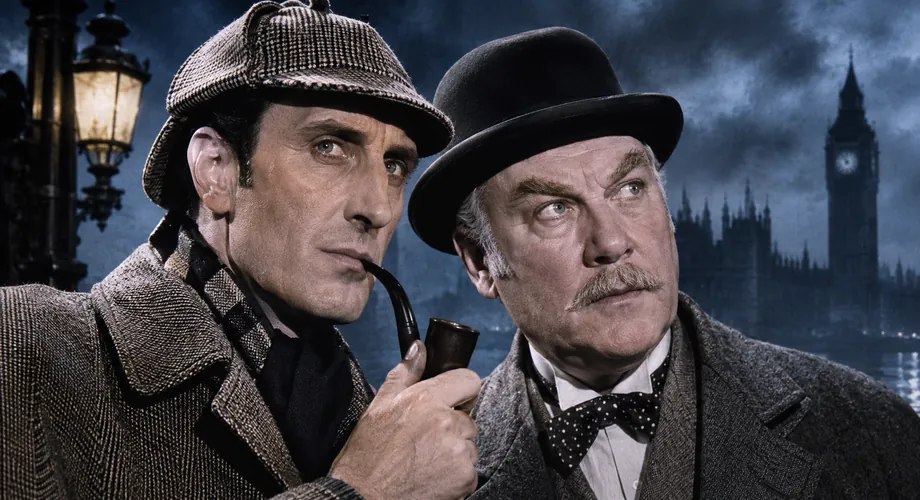
When people think of Sherlock Holmes on screen, numerous actors have taken on the famous detective over the years. However, few have become as closely associated with the character as Basil Rathbone. Alongside Nigel Bruce as Dr Watson, Rathbone starred in fourteen films between 1939 and 1946, creating one of cinema's most recognisable detective partnerships.
Born in Johannesburg, South Africa, on 13 June 1892, Philip St John Basil Rathbone was the son of British parents. His family returned to England when he was a young child, and he was educated at Repton School in Derbyshire. Although his father initially favoured a conventional career, Rathbone had other ambitions. After a brief spell working as an insurance clerk, he turned his attention to acting, joining the theatrical company of his cousin, the distinguished Shakespearean actor Sir Frank Benson.
Rathbone made his professional stage debut in 1911 as Hortensio in Shakespeare's The Taming of the Shrew. He quickly developed his theatrical skills, appearing in numerous Shakespearean productions before establishing himself on the London stage. His career was interrupted by the First World War, during which he served with the Liverpool Scottish Regiment. He was awarded the Military Cross in 1918 for his service.
Following the war, Rathbone returned to acting, working in both British and American theatre before turning increasingly towards the cinema. His early screen career included a mixture of romantic roles, historical dramas and adventure films. By the mid-1930s, Hollywood had begun to make particularly good use of his commanding presence and distinctive voice, often casting him as an aristocratic villain or formidable adversary.
Among his notable appearances during this period were Captain Blood (1935), David Copperfield (1935), Romeo and Juliet (1936) and The Adventures of Robin Hood (1938). In the latter, he played Sir Guy of Gisbourne opposite Errol Flynn's Robin Hood. Their sword-fighting encounters became some of the film's most memorable sequences, with Rathbone's considerable fencing ability making him a convincing opponent.
His performance as Tybalt in Romeo and Juliet earned him an Academy Award nomination for Best Supporting Actor in 1937. He received a second nomination for his portrayal of King Louis XI in If I Were King (1938). By the end of the decade, Rathbone was an established Hollywood actor with an impressive range of performances behind him. His next major role, however, would become the one for which he is remembered above all others.
William Nigel Ernle Bruce was born on 4 February 1895 in Ensenada, Mexico, to British parents. Despite his unusual birthplace, he was very much an Englishman, educated in England and coming from a distinguished family with aristocratic connections. Like Basil Rathbone, his early life would be interrupted by the First World War, during which he served in the British Army. He was seriously wounded in action, suffering a leg injury that would affect him for the rest of his life.
Following his military service, Bruce turned to acting, initially working in the theatre before gradually establishing himself on screen. His film career included appearances in Treasure Island (1934), The Scarlet Pimpernel (1935) and The Charge of the Light Brigade (1936). He became particularly well suited to playing upper-class English gentlemen, military officers and occasionally rather pompous characters, often bringing a gentle comic touch to his performances.
Before taking on the role of Dr Watson, Bruce had already appeared in a number of notable Hollywood productions. His performances in Alfred Hitchcock's Rebecca (1940) and Suspicion (1941) demonstrated his ability to play more than just comic supporting characters. In both films, he brought a distinctive warmth and personality to his roles, qualities that would become equally important in his portrayal of Watson.
When Bruce first appeared alongside Rathbone in The Hound of the Baskervilles (1939), his interpretation of Watson was quite different from the capable and observant character found in Arthur Conan Doyle's original stories. His Watson was often bewildered by Holmes's deductions, occasionally clumsy and frequently the source of comic relief. This interpretation attracted criticism from some Sherlock Holmes enthusiasts, who felt it made Watson appear less intelligent than he should have been. Nevertheless, Bruce's performance proved immensely popular with audiences.
There was considerably more to the partnership than the films alone. Rathbone and Bruce also brought Holmes and Watson to radio in The New Adventures of Sherlock Holmes, beginning in 1939. The series ran for several years and featured the two actors in well over 200 broadcasts. The radio version generally gave Watson a more capable role, allowing Bruce to demonstrate a different side of the character.
Bruce remained closely associated with Watson for the rest of his career, appearing in all fourteen films alongside Rathbone. Away from the detective series, he continued to work in Hollywood, including a memorable appearance in Charlie Chaplin's Limelight (1952). Sadly, Bruce died of a heart attack on 8 October 1953, aged just 58. His portrayal of Dr Watson, with its mixture of warmth, humour and occasional bluster, remains one of the most recognisable interpretations of the character.
In 1938, 20th Century Fox brought Basil Rathbone and Nigel Bruce together for a new screen interpretation of Sherlock Holmes and Dr Watson. Their first film, The Hound of the Baskervilles, was released on 31 March 1939. Based on Arthur Conan Doyle's celebrated 1902 novel, it provided an ideal introduction to the two actors in their now-famous roles.
Set against the bleak and atmospheric landscape of Dartmoor, the story follows Sir Henry Baskerville, the latest heir to an ancient family estate haunted by a terrifying legend. According to local superstition, a monstrous hound has pursued the Baskerville family for generations. With the mysterious death of Sir Henry's predecessor and the possibility of another tragedy, Holmes is called upon to investigate. The film also features Richard Greene as Sir Henry, Wendy Barrie as Beryl Stapleton and Lionel Atwill as Dr Mortimer.
Fox gave the production an impressive scale, with elaborate sets and a particularly memorable recreation of the Great Grimpen Mire. The fog-shrouded moor provides much of the film's atmosphere, while Rathbone's sharp, assured performance establishes a formidable Holmes. Nigel Bruce also makes an immediate impression as Watson, bringing warmth and humour to the partnership. Although Holmes remains very much the central figure, the contrast between the two performances would become one of the series' defining features.
The second film, The Adventures of Sherlock Holmes, followed on 1 September 1939. Directed by Alfred Werker, it brought the pair back together in another Victorian mystery, this time involving Professor Moriarty, played by George Zucco. Moriarty devises an elaborate scheme involving the Crown Jewels and a series of sinister threats against a wealthy family. Holmes must unravel the deception while attempting to prevent his old adversary from carrying out the crime of the century.
The film also features Ida Lupino as Ann Brandon and Terry Kilburn as Billy. Although its screen credits refer to William Gillette's famous stage play, the story bears little resemblance to the original theatrical production. Nevertheless, it provides another entertaining mystery and gives Rathbone and Bruce further opportunity to establish their interpretations of the characters.
These two Fox productions were the only films in the series to retain the traditional Victorian setting of Conan Doyle's stories. They also laid the foundations for one of cinema's most enduring detective partnerships. When Universal Pictures took over the series a few years later, the setting and style would change considerably, but Rathbone and Bruce would remain at its centre.
Following the success of the two Fox productions, Universal Pictures acquired the film rights to a selection of Sherlock Holmes stories in 1942. Basil Rathbone and Nigel Bruce were persuaded to return, but the new studio had rather different ideas about the direction of the series. Instead of maintaining the Victorian setting of Conan Doyle's original stories, Universal transported Holmes and Watson into the modern world of the 1940s, placing them in the middle of the Second World War.
The first Universal production, Sherlock Holmes and the Voice of Terror (1942), introduced this new approach. Based loosely on Conan Doyle's short story His Last Bow, the film sees Holmes investigating a mysterious radio broadcaster known as the Voice of Terror, whose frightening transmissions are spreading fear across Britain. The story was adapted to reflect the wartime situation, with Holmes taking on an enemy spy network operating on British soil.
This was followed by Sherlock Holmes and the Secret Weapon, in which Holmes attempts to protect a brilliant scientist and his revolutionary new bomb sight from falling into German hands. Professor Moriarty, played by Lionel Atwill, makes another appearance, this time working alongside the enemy. The third film, Sherlock Holmes in Washington (1943), takes the detective across the Atlantic to recover a stolen secret document, again involving an international espionage plot.
These first three Universal films were firmly rooted in wartime concerns, reflecting the anxieties and propaganda themes of the period. However, the series gradually moved away from direct references to the conflict, returning to more familiar murder mysteries, criminal conspiracies and sinister adversaries.
With Sherlock Holmes Faces Death (1943), the detective finds himself investigating a murder at a country house occupied by convalescing soldiers. The following films brought a variety of unusual cases, including The Spider Woman (1944), featuring a mysterious series of deaths, and The Scarlet Claw (1944), in which Holmes investigates a terrifying legend surrounding a remote Canadian village.
The Pearl of Death (1944) introduced a particularly memorable villain in the form of the murderous Hoxton Creeper, played by Rondo Hatton. The story draws inspiration from Conan Doyle's short story The Adventure of the Six Napoleons. This was followed by The House of Fear (1945), involving a group of men known as the Good Comrades, whose members begin dying under mysterious circumstances.
The series continued with The Woman in Green (1945), another encounter with Professor Moriarty, and Pursuit to Algiers (1945), which takes Holmes and Watson aboard a passenger ship while protecting a young royal heir. The final two films were Terror by Night (1946), set aboard a train travelling from London to Edinburgh, and Dressed to Kill (1946), which brought the fourteen-film series to a close with a mystery involving stolen banknote printing plates.
Director Roy William Neill became closely associated with the Universal series, directing eleven of its twelve films. His contribution helped establish a consistent style, combining atmospheric settings, unusual murder mysteries and a steady supply of colourful villains. The only Universal entry not directed by Neill was Sherlock Holmes and the Voice of Terror, which was directed by John Rawlins.
By the time Dressed to Kill reached cinemas in 1946, Rathbone and Bruce had spent seven years bringing Holmes and Watson to the screen. The Universal films had taken the characters in a very different direction from the original Fox productions, but the central partnership remained intact. Whatever the setting or the nature of the mystery, audiences continued to enjoy seeing the two actors together.
More than eighty years after their first appearance together, Basil Rathbone and Nigel Bruce remain among the most celebrated actors to have portrayed Sherlock Holmes and Dr Watson. Their fourteen films introduced generations of cinema audiences to the famous detective and his loyal companion, helping establish an enduring screen image of the Baker Street partnership.
Rathbone's portrayal became a benchmark for subsequent actors taking on the role. His distinctive voice, sharp delivery and commanding presence captured much of the intelligence and theatricality associated with Holmes. Although later adaptations would offer very different interpretations, his performance remains one of the defining versions of the character.
Nigel Bruce's contribution should not be overlooked either. Despite the differences between his Watson and Conan Doyle's original creation, his warmth and comic timing gave the films a personality all of their own. Together, Rathbone and Bruce created a partnership that has stood the test of time, ensuring that their adventures remain an important part of Sherlock Holmes film history.
ARTICLE CATEGORY
Films