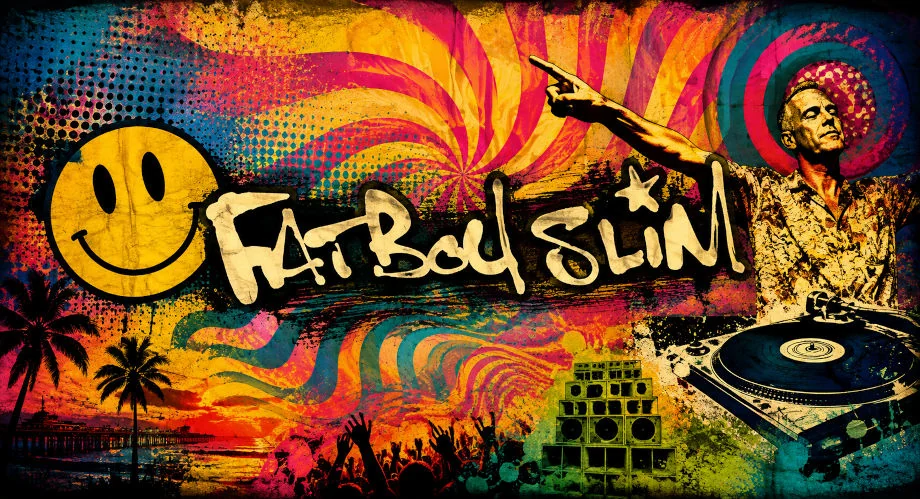
Norman Cook, better known to the world as Fatboy Slim, is one of the most influential and beloved figures in dance music history. With his infectious grooves, sample-heavy production, and larger-than-life stage presence, he became the poster boy for the big beat movement of the 1990s and helped bring electronic music to a mainstream audience that had never set foot in a nightclub. Decades on, his songs are still instantly recognizable from the opening bar, his videos are still held up as some of the most creative in the medium's history, and his live shows remain some of the most joyous, chaotic, and beloved spectacles in music. Few artists have managed to stay musically relevant and commercially successful across as many different eras and trends as Cook has, and fewer still have done it while maintaining the sense of humour and warmth that has always defined the Fatboy Slim persona.
Fatboy Slim
Praise You
Quentin Leo Cook, who later adopted the name Norman Cook, was born on July 31, 1963, in Bromley, on the outskirts of London, and grew up in the nearby town of Reigate, Surrey. As a teenager he became consumed by music, spending his pocket money on soul, funk, and reggae records and haunting local record shops in search of obscure imports. He has often credited this early, indiscriminate appetite for different genres as the root of his later willingness to sample and blend sounds that other producers would have kept separate.
Before he ever stepped behind a mixing desk professionally, Cook was DJing at local youth clubs and parties, building a reputation among friends for an eclectic and unpredictable selection of records. He studied at the University of Brighton, a city that would later become permanently associated with his career and public identity, and it was there that he first began to seriously pursue music as more than just a hobby.
Fatboy Slim
Rockafeller Skank
Cook's first real brush with fame came as the bassist for The Housemartins, a jangly, politically outspoken indie-pop band from Hull that scored major success in the mid 1980s. Their breakthrough single, "Happy Hour," released in 1986, combined chiming guitars with sharp social commentary and became a fixture on British radio and television. The band followed it with "Caravan of Love," an a cappella cover that unexpectedly reached number one on the UK singles chart at the end of that year, a remarkable feat for a group known primarily for guitar pop.
The Housemartins were unusual pop stars: outspokenly left-wing, committed to a do-it-yourself ethic, and often uneasy with the trappings of fame that came with chart success. Cook's melodic, funk-influenced basslines were a key part of the band's sound, and the experience gave him his first real education in songwriting, recording, and the mechanics of the music industry. When the band split in 1988, citing creative differences and a desire to pursue other paths, Cook did not take time off. Instead, he threw himself headfirst into the acid house and rave culture that was exploding across Britain at exactly that moment.
Almost immediately after The Housemartins ended, Cook formed Beats International, a project that fused dub reggae, hip-hop production techniques, and pop songwriting into something distinctly new for the time. The group's cover of the SOS Band's "Just Be Good to Me," retitled "Dub Be Good to Me" and built around a prominent bassline lifted from The Clash's "Guns of Brixton," topped the UK singles chart in 1990. It gave Cook his first taste of chart success as a producer and bandleader rather than simply as a band member, and it foreshadowed the sample-heavy approach that would come to define his later work.
Over the next several years, Cook cycled through a dizzying string of aliases and side projects, seemingly incapable of settling on a single sound or identity. As Freak Power, he scored a hit with "Turn On, Tune In, Cop Out," later famous for soundtracking a well-known jeans advertisement. As Pizzaman, he explored more straightforward house music. As The Mighty Dub Katz, he leaned further into dub and breakbeat textures. Each project functioned as a kind of experiment, allowing him to test out different sounds, tempos, and production techniques without the commercial pressure attached to a single defined artist name. This restless, genre-hopping creativity, jumping between projects and never settling on one identity for long, would become the defining trait that eventually led him to the persona that made him a household name.
Fatboy Slim
Right Here, Right Now
The Fatboy Slim name emerged in the mid 1990s, reportedly inspired in part by American professional wrestling nicknames and partly as a way for Cook to separate this new, groove-heavy project from his other ongoing work. With the new name came a signature sound that would soon become instantly recognizable: chunky, driving breakbeats, deep rolling basslines, and irresistibly catchy vocal samples chopped, pitched, stretched, and looped into something that felt both strangely familiar and completely new.
His 1996 debut album under the Fatboy Slim name, Better Living Through Chemistry, laid the groundwork for what was to come, blending acid house textures with the breakbeat energy that was rapidly taking over British clubs at the time. The record was well received within dance music circles and established Cook as a producer to watch, but it was his second album that would transform him from a respected underground name into a genuine global phenomenon.
Released in 1998, You've Come a Long Way, Baby sold millions of copies worldwide and crossed over into homes that had never previously owned a dance record. It remains widely regarded as one of the defining albums of the big beat era and one of the best-selling electronic albums of all time.
The record spawned a run of tracks that became inescapable across radio, television, film, and advertising. "The Rockafeller Skank" became a global anthem thanks to its warped, pitch-shifted guitar sample and its shouted refrain of "right about now, the funk soul brother," turning up everywhere from car commercials to sporting arenas and remaining a staple of Fatboy Slim's live sets to this day. "Praise You" was propelled to even greater cultural prominence by an now-iconic music video from director Spike Jonze, in which a fictional amateur dance troupe called the Torrance Community Dance Group performed a deliberately clumsy, joyfully unpolished routine in front of a Los Angeles cinema. The video, shot guerrilla-style with unsuspecting bystanders looking on, won several MTV Video Music Awards and is still frequently cited as one of the greatest music videos ever made. "Gangster Trippin'" and "Right Here, Right Now" rounded out the album's run of hits, with the latter becoming a favourite for use in film trailers, sporting montages, and political campaign videos thanks to its triumphant, escalating build.
Fatboy Slim
ft. Bootsy Collins
Weapon Of Choice
Fatboy Slim became the figurehead of big beat, a genre that fused breakbeat, house, and rock energy into something loud, playful, and instantly accessible to listeners who had never previously considered themselves fans of electronic music. Alongside acts like The Chemical Brothers, The Prodigy, and Basement Jaxx, he helped prove that dance music could headline major festivals and fill arenas rather than remaining confined to underground warehouse raves and late-night clubs.
This period also saw Cook become an unlikely mainstream celebrity in Britain, appearing on television chat shows, headlining Glastonbury and other major festivals, and becoming closely associated with the optimistic, brash cultural mood of Britain in the late 1990s. His accessible, funny, and self-deprecating public persona helped dance music shed some of its underground reputation for a mainstream audience that might otherwise have found it intimidating or impenetrable.
His follow-up album, Halfway Between the Gutter and the Stars, arrived in 2000 and leaned into a funkier, more soulful direction than its predecessor. It featured a notable collaboration with American singer Macy Gray on the track "Demons," as well as a track built around a sample of Jim Morrison's spoken word recordings, licensed with the cooperation of The Doors' surviving members. While the record did not replicate the meteoric commercial success of You've Come a Long Way, Baby, it was still a commercial success in its own right and further cemented Cook's reputation as a producer unafraid to experiment and pull inspiration from unexpected sources.
In the years that followed, Fatboy Slim continued to release music steadily, refusing to simply repeat the formula that had made him famous. Palookaville arrived in 2004, taking a slightly more contemplative and eclectic approach than his earlier work, and included the widely licensed track "Slash Dot Dash." He later teamed up with singer-songwriter Riva Starr and, notably, collaborated with David Byrne of Talking Heads on the concept album Here Lies Love, a genre-bending song cycle about former Philippine first lady Imelda Marcos that was later adapted into a stage musical.
Throughout this period, Cook also remained one of the most in-demand remixers in the music business. His remix work touched artists as varied as The Rolling Stones, Michael Jackson, Cornershop, and Groove Armada, each reworked with his unmistakable stamp of chopped vocal samples, rolling breakbeats, and an unerring sense of when to drop the bassline for maximum dancefloor impact.
Fatboy Slim
Ya Mama
(Push The Tempo)
Beyond the studio, Fatboy Slim built a reputation as one of the most electrifying live performers in dance music, and nowhere was this more evident than on Brighton Beach, the seaside city he had adopted as his home. His free outdoor concert in July 2002, known as Big Beach Boutique II, drew an estimated quarter of a million people to the beach, a turnout far beyond what organisers had anticipated. The sheer scale of the crowd caused significant transport chaos across the city and led to tighter restrictions on future free events, but it also became the stuff of festival legend, frequently cited as one of the greatest free concerts in British music history.
His live shows more broadly became known for their sense of joy, colour, and inclusivity: giant smiley face visuals, confetti cannons, elaborate stage production, and a DJ who always looked like he was having just as much fun as the crowd in front of him. That infectious, unpretentious charisma has kept him relevant and in demand across three decades of shifting dance music trends, long after many of his original big beat contemporaries faded from the spotlight.
Cook has long been married to British radio and television presenter Zoe Ball, one of the country's most recognisable broadcasting personalities, and the couple has become something of a fixture in UK popular culture over the years, with their relationship and family life widely covered in the British press.
He has also been candid over the years about his struggles with alcohol, which at times became a serious problem during the height of his fame and relentless touring schedule in the late 1990s and early 2000s. Eventually giving up drinking entirely was a decision he has said helped him rediscover his genuine passion for performing and production, rather than simply going through the motions of festival culture on autopilot. He has spoken openly in interviews about how sobriety changed his relationship with music and performance for the better, allowing him to appreciate his own shows and audiences in a way he couldn't while drinking heavily.
Fatboy Slim
Gangster Trippin
Over the course of his career, Fatboy Slim has picked up numerous awards, including multiple MTV Video Music Awards for the "Praise You" video, BRIT Award recognition, and inclusion in countless "greatest dance tracks of all time" and "greatest music videos of all time" lists compiled by music publications. He has also received an honorary degree and various forms of civic recognition in Brighton, the city most closely associated with his identity and career.
Decades after "The Rockafeller Skank" first blared out of car radios, Fatboy Slim's influence remains everywhere in dance music, from the sample-based production techniques he helped popularize to the enduring idea that a DJ set can be a genuine communal spectacle rather than simply background music for a night out. His willingness to blend genres, embrace humour, and prioritise a sense of collective joy over cool detachment helped open the door for dance music to become a genuinely mainstream cultural force in Britain and beyond.
He continues to tour and perform regularly around the world, remaining a beloved elder statesman of the scene he helped define for a generation of listeners who came of age in the late 1990s. Few artists have managed to make electronic music feel so unpretentious, so danceable, and so much fun, and that combination is exactly why Fatboy Slim's legacy continues to endure, decades after he first stepped behind the decks under that name.
ARTICLE CATEGORY
Music