War of the Worlds
Full Album
Jeff Wayne's Musical Version of The War of the Worlds is a double concept album composed and produced by the American-born British musician Jeff Wayne, released on 9 June 1978 by CBS Records. A retelling of H. G. Wells's 1898 science-fiction novel The War of the Worlds, it blends progressive rock, orchestral scoring, disco-inflected rhythm, and dramatic spoken narration to dramatize a Martian invasion of Victorian England. Running to roughly 95 minutes across two discs, it stands as one of the best-selling and most culturally persistent concept albums ever produced in Britain, with worldwide sales widely reported in excess of 15 million copies and a run of six years on the UK album charts.
Beyond the record itself, the project has expanded over more than four decades into compilation albums, foreign-language editions, a full re-recording, DVD and Blu-ray concert films, four separate video games, an immersive walk-through experience, a West End stage production, and repeated arena and theatre tours — making it as much an ongoing multimedia franchise as a single album.
Jeff Wayne was born in New York and raised partly in California, initially setting out to study journalism before turning to music, studying jazz piano at the Juilliard School. He moved to the United Kingdom in 1966, drawn into the London music scene after his father, actor and producer Jerry Wayne, staged the West End musical Two Cities — an adaptation of Charles Dickens's A Tale of Two Cities — for which the younger Wayne composed the score. The production was a success, and its star, Edward Woodward, won the Evening Standard Award for Best Male Performance in a Musical for the role.
Through the late 1960s and into the 1970s, Wayne built a career as a jobbing composer and arranger, writing an estimated 3,000 advertising jingles for UK television — including campaigns for Gordon's Gin, Abbey National, and British Airways — as well as scoring long-running television themes, among them ITV's World of Sport and coverage of the World Cup. He moved into record production in the early 1970s, most notably producing David Essex's breakthrough album Rock On, whose title track reached number one, and continuing to work with Essex across subsequent albums and the film Stardust. This period also connected Wayne with musicians such as guitarist Chris Spedding, who would go on to play key roles in the War of the Worlds sessions. Wayne additionally scored the 1977 thriller film Golden Rendezvous, starring Richard Harris.
By the mid-1970s, Wayne felt his work as a composer, rather than producer, had stagnated, and began searching for a large-scale story to adapt musically. It was his father who suggested Wells's novel, lending Jeff a copy of The War of the Worlds and prompting the idea that would occupy him for the rest of the decade.
Wayne secured the musical adaptation rights to the novel from the H. G. Wells estate in 1975, and development stretched across roughly three years. The album's spoken dialogue and script were written by Wayne together with his wife, Doreen Wayne, drawing directly on passages and structure from Wells's original text so that listeners could follow the plot almost scene by scene. The bulk of the song lyrics were written by Gary Osborne, with additional early contributions from Paul Vigrass, whose melody with Wayne would eventually become "Forever Autumn." The album's original budget of around £35,000 expanded considerably over the course of the ambitious production.
Recording took place over more than a year, from May 1976 to June/July 1977, primarily at Advision Studios in London, with string orchestration recorded at Abbey Road Studios. Actor Richard Burton's narration, which forms the spine of the album's storytelling, was recorded separately at Wally Heider Studios in San Francisco. The finished album was assembled from a 48-track production — an ambitious multitrack process for the era — layering rock band performances, a purpose-formed string orchestra, early synthesizer work, and narration into a continuous piece of musical storytelling. Session keyboardist and synthesizer specialist Ken Freeman played a central role in shaping the album's distinctive electronic textures, alongside the more conventional rock instrumentation of the Black Smoke Band.
The finished record premiered for the press and industry guests at the London Planetarium on 1 June 1978, a fittingly theatrical launch for an album about an alien invasion, before going on general sale on 9 June 1978.
The album is structured into two "books," echoing the two-part division of Wells's original novel:
A framing prologue, delivered by the Journalist, sets up humanity's obliviousness to the possibility of alien life even as Mars quietly observes Earth. Throughout, Wayne uses recurring musical leitmotifs — instrumental themes tied to specific characters, moods, or forces (the Martians' menace, the Journalist's love for Carrie, humanity's despair and resolve) — to bind the narration and songs into a coherent musical drama, a technique often compared to the character-driven scoring found in film or rock-opera works such as Jesus Christ Superstar. Wayne has spoken of the story as a meditation on human pride and the limits of technological confidence, with mankind ultimately saved not by ingenuity but by the humblest of Earth's organisms.
Because the album is structured as continuous narration interwoven with song, its track list doubles as a plot outline. A brief guide to how the story unfolds:
The Journalist sets the scene: astronomers have observed strange flashes on Mars, dismissed by the wider public as insignificant. The track establishes the album's central instrumental theme and the ominous "Ulla" motif associated with the Martians.
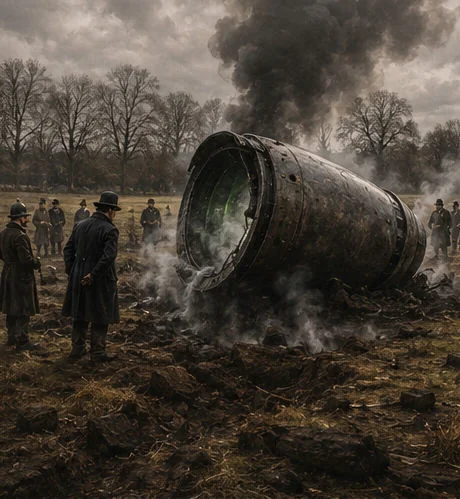
A Martian cylinder lands near the Journalist's home. Curious crowds gather, and the Martians respond by unleashing the Heat-Ray, killing dozens instantly and beginning the invasion in earnest.
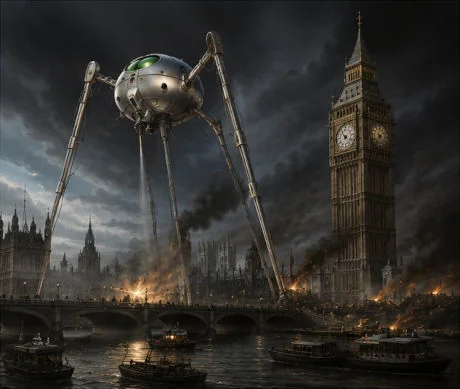
The Journalist encounters a soldier, the Artilleryman, and witnesses the first towering Martian fighting machines advancing across the countryside, destroying the British Army's efforts to resist.
Amid the chaos, the Journalist is separated from his fiancée, Carrie, whom he has sent to safety in America. The song, sung by Justin Hayward, became the album's signature ballad and its biggest hit single.
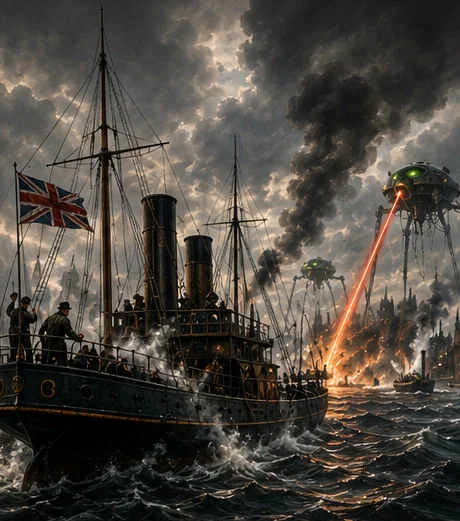
As refugees flee to the coast, the Royal Navy ironclad HMS Thunder Child sacrifices itself to destroy several Martian machines, allowing evacuation ships to escape — a rare moment of human triumph in the story.
Weeks pass. A strange red Martian vegetation spreads uncontrollably across the land as the Journalist wanders a devastated England, encountering the physical and psychological wreckage of the invasion.
The Journalist shelters with the increasingly unstable Parson Nathaniel and his wife Beth. The Parson interprets the invasion as an apocalyptic judgment, while Beth pleads for reason, leading to a violent confrontation.
The Journalist reunites with the Artilleryman, now living in the ruins and fantasizing about rebuilding a hidden human civilization underground to one day retake the surface — a plan the Journalist recognizes as more delusion than strategy.
The Journalist leaves the Artilleryman and continues alone through the devastated landscape toward London, reflecting on what kind of world might emerge from the ruins.
The Journalist reaches an eerily silent, abandoned London, only to discover the Martians have already begun dying, felled by Earth's bacteria, to which they had no immunity — the invasion's abrupt and unexpected end.
The story closes with the Journalist reunited with Carrie, and a reprise of the album's opening themes reflecting on humanity's narrow survival and its uncertain future.
Most tracks were composed by Wayne with lyrics by Gary Osborne; "Forever Autumn" carries a writing credit shared with Paul Vigrass, drawing on an earlier melody the two had written together before it was reworked for the album.
The original 1978 recording assembled an eclectic "all-star" cast spanning theatre, rock, and pop:
Behind the star cast, Wayne conducted a dedicated group of session musicians who later became known as the Black Smoke Band, including bassist Herbie Flowers, guitarist Chris Spedding, and keyboardist/synthesizer player Ken Freeman, whose work helped define the album's futuristic textures (Freeman would later compose the theme music for BBC television's Casualty and Holby City). Alongside the band, Wayne assembled the ULLAdubULLA Strings, an orchestra formed specifically to record the album's string arrangements — its name a reference to the Martians' distinctive cry.
Notably, Wayne originally approached actor and singer Roger Daltrey of The Who to play Parson Nathaniel; Daltrey declined, reportedly wary of being typecast after recently playing a man of faith on screen, and the role went instead to Phil Lynott.
The album received widespread critical acclaim on release, praised in the contemporary press with descriptions such as "magnificent" and "four sides of sheer excellence." Commercially it was an outsized success: it spent six years on the UK album chart, has been credited with UK sales alone exceeding 2.5 million copies (making it one of the best-selling albums in UK chart history, and by some measures the biggest-selling stand-alone (non-compilation, non-soundtrack) studio album of all time), and has gone multi-platinum. Its worldwide sales are commonly cited at around 15 million copies.
The album's lead single, "Forever Autumn," released ahead of the album on 2 June 1978, reached the UK top five. Further singles followed through the rest of 1978, including "The Eve of the War," "Brave New World," and "Thunderchild." A later 1989 remix of "The Eve of the War" by Ben Liebrand returned the track to the UK singles chart, reaching number three, introducing the album's music to a new generation of listeners more than a decade after its original release.
Industry recognition included two Ivor Novello Awards, and in 1979 the album received a Best Recording in Science Fiction and Fantasy honor from a judging panel that notably included Alfred Hitchcock, George Lucas, and Steven Spielberg.
| Milestone | Detail |
|---|---|
| UK album chart run | Approximately 6 years on the chart following release |
| UK sales | Over 2.5 million copies |
| Worldwide sales | Commonly cited at approximately 15 million copies |
| "Forever Autumn" (single) | UK Top 5, 1978 |
| "The Eve of the War" (1989 remix) | No. 3, UK Singles Chart |
| Awards | Two Ivor Novello Awards; 1979 Best SF/Fantasy Recording |
To promote the original release, CBS distributed an abridged "radio edit" version of the album to stations, adding special intros and outros to songs that had not originally been written with radio play in mind. This promotional edit proved popular enough that Columbia Records issued it commercially in 1981 as Highlights from Jeff Wayne's Musical Version of The War of the Worlds, a single-disc compilation that reordered and trimmed material to foreground the songs over the dialogue-heavy passages, at some cost to narrative coherence. It has since been reissued multiple times with bonus remixes, including a 2000 reissue adding the 1989 Ben Liebrand remix of "The Eve of the War" and a 1996 remix of "Forever Autumn," and a 2007 edition featuring a new mix of "The Spirit of Man."
The album's popularity led to several foreign-language adaptations:
In 2012, Wayne released a substantially re-recorded version of the album titled Jeff Wayne's Musical Version of The War of the Worlds – The New Generation, featuring a new cast including Liam Neeson as the Journalist. Released by Sony Music in November 2012, it reached number 13 on the UK album chart. The New Generation version was accompanied by an arena tour and later formed the basis of a stage adaptation.
Although Wayne had explored the idea of a stage version as early as 1978 — including talks with Paramount Pictures over film rights and discussions with concert producers such as Showco — it was not until 2006 that a full live touring production was mounted.
Musicians Herbie Flowers and Chris Spedding, both present on the original 1978 studio recording, have returned as members of the Black Smoke Band across multiple subsequent tours, providing a direct musical link between the original album and its later stage incarnations.
The album has been remastered and repackaged repeatedly for anniversaries and new audio formats, including a 25th-anniversary edition reworked into 5.1 surround sound by engineers Gaëtan Schurrer and Gary Langan (the latter a founding member of the Art of Noise), Super Bit Mapping remasters, hybrid SACD "Collector's Edition" releases with expanded 48-page booklets and new artwork, and an 18-disc deluxe box set produced for a more recent anniversary, packaged with a 156-page hardback book and two Blu-ray discs.
More than four decades on, Jeff Wayne's Musical Version of The War of the Worlds remains deeply embedded in British popular culture. Its most famous musical phrase — the ominous "Ulla" motif associated with the Martians — and songs such as "Forever Autumn" and "The Eve of the War" continue to be widely recognized outside the context of the full album. The record's influence extends into other genres: its melodies have been sampled and reworked by electronic and drum and bass acts, including a well-known interpretation of "Thunder Child" by the artist Logistics, as well as tracks by On Remand and Pendulum.
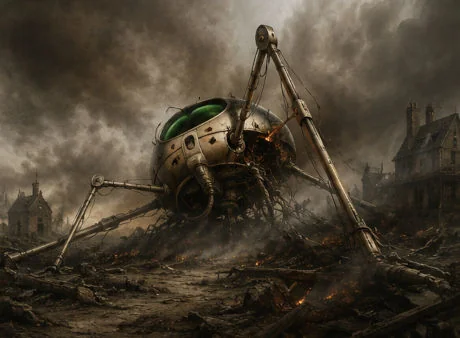
One retrospective assessment described the album's cover art and towering Martian war machines, illustrated by Michael Trim, as having permeated the popular psyche in Britain in much the way the source novel's imagery once did.
The project's continual revival — through re-recordings, arena spectacles, a West End run, an immersive experience, four video games, and further touring planned into 2026 — reflects an unusually long commercial and creative afterlife for a late-1970s concept album, and cements its status as one of the defining British musical adaptations of H. G. Wells's novel.
ARTICLE CATEGORY
Music