For three days in August 1969, a dairy farm in Bethel, New York, became the site of the most extraordinary gathering in the history of live music. Nearly half a million people arrived expecting a concert. What they found was something closer to a temporary nation — one built on music, generosity, and the improbable goodwill of strangers looking out for each other in a sea of mud and sound.
Woodstock's lineup alone would have made it legendary: Jimi Hendrix, Janis Joplin, Santana, The Who, Sly and the Family Stone, Crosby Stills Nash & Young, Creedence Clearwater Revival, and dozens more, many delivering the defining performances of their careers, back to back, for three straight days. But what turned Woodstock into a cultural touchstone — the reason people are still writing about it more than fifty years later — was the atmosphere. Half a million people, most of them strangers to one another, showed up to a farm with more music than infrastructure, and chose to take care of each other anyway. That spirit is Woodstock's real legacy, and it's worth telling in full, alongside the music that made the weekend unforgettable.

The festival's roots trace back to four young promoters — John Roberts, Joel Rosenman, Artie Kornfeld, and Michael Lang — who set out to throw an ambitious outdoor concert in the summer of 1969, inspired by the town of Woodstock, New York, an established artists' retreat where Bob Dylan and other musicians had homes. The original venue fell through just weeks before the show, and with tickets already selling and a historic lineup already booked, the promoters needed a new site fast.
That's when Max Yasgur, a dairy farmer in the town of Bethel, stepped in. Yasgur leased 600 rolling acres of alfalfa and pasture to the festival, and in doing so gave Woodstock its natural amphitheater — a gentle bowl-shaped field sloping down toward a stage, perfectly suited, almost by accident, to hosting a crowd of enormous size. Yasgur later addressed the audience himself from the stage, telling the massive crowd that they'd proven to the world that half a million young people could come together for three days of fun and music and have nothing but fun and music. It's one of the most quietly moving moments of the entire weekend: a conservative, middle-aged farmer, embraced by a generation of young people he had every reason to find bewildering, thanking them for how well they'd treated each other and his land.
Woodstock
3 Days That Changed Everything
(Full Documentary)
The promoters planned for a crowd of 50,000 to 100,000. Somewhere between 400,000 and 500,000 people showed up instead, arriving by car, by bus, and increasingly on foot once Route 17B became an impassable, miles-long river of abandoned vehicles. For a few days, the festival grounds became, in effect, the third-largest city in New York State.
What's remarkable isn't that a crowd that size created challenges — it's how the community around Woodstock rose to meet them, almost entirely through improvisation and generosity rather than formal planning. The traveling commune known as the Hog Farm, led by Wavy Gravy, had been brought in to help with site work, and ended up running free kitchens that fed thousands of people a day, cooking granola, oatmeal, and stew in enormous batches for anyone who was hungry. Doctors and nurses who had come simply to enjoy the music found themselves running medical tents, treating everything from blistered feet to bad reactions to the summer heat, and helping deliver at least two babies born on festival grounds. When the roads became too clogged for supply trucks, the New York National Guard flew in food, medical supplies, and even performers by helicopter.
Heavy rain on Saturday and Sunday turned the fields into the mud that's now inseparable from Woodstock's imagery — but even that became part of the festival's spirit, as people slid, danced, and laughed their way through it rather than letting it sour the mood. Performers, including Joe Cocker and Country Joe McDonald, led the crowd in singalongs to keep spirits up during the rain delays. Announcements from the stage about lost friends, medical tents, and free food were met, by most accounts, with patience and even humor rather than panic. For an event that had every structural reason to fall apart, what actually happened was hundreds of thousands of strangers quietly deciding to look after one another for three days straight.
Thirty-two acts performed at Woodstock, across genres and generations, and an extraordinary number of them delivered performances now considered among the greatest of their careers.
The festival opened with Richie Havens, sent out to buy time while performers stuck in traffic made their way to the grounds. Havens played far longer than planned, and when he ran out of songs, he improvised one on the spot, built around a single word repeated like a prayer: "Freedom." It remains one of the most electrifying opening performances in festival history, and a perfect encapsulation of Woodstock's spirit — something extraordinary, born entirely out of the moment.
The rest of the evening leaned gentle and acoustic: Sweetwater, the Incredible String Band, Bert Sommer, Tim Hardin, Ravi Shankar, whose sitar performance drifted out over the crowd as rain began to fall, and Melanie, performing to candlelight after organizers asked the audience to light candles against the darkness. Arlo Guthrie brought warmth and humor fresh off the success of "Alice's Restaurant," and Joan Baez closed the night eight months pregnant, her voice carrying over a quiet, seated crowd under an open sky filled with more stars than most of the attendees, coming from cities, had ever seen at once.
Santana
Soul Sacrifice
1969 Woodstock
Saturday is the day most people picture when they think of Woodstock, and for good reason. Santana, a band that hadn't yet released its debut album, tore through a set built around the instrumental "Soul Sacrifice," announcing themselves to the world in the space of a single afternoon. Nineteen-year-old drummer Michael Shrieve's extended solo during that performance became one of the most iconic pieces of footage in the eventual documentary — a teenager, essentially unknown before that day, playing to hundreds of thousands of people and holding every one of them.
Jefferson Airplane
Woodstock 1969
From there, the day rolled through Canned Heat, Mountain, Grateful Dead, Creedence Clearwater Revival, and Janis Joplin, whose ferocious, full-hearted set with the Kozmic Blues Band is remembered as one of the finest live performances of her career. As Saturday night gave way to Sunday morning, Sly and the Family Stone took the stage and delivered what many who were there still call the single greatest set of the weekend — "I Want to Take You Higher," performed at nearly four in the morning, turned an exhausted, rain-soaked crowd into a joyful mass singalong that seemed to summon fresh energy out of nowhere. The Who followed with a full performance of their rock opera "Tommy," and Jefferson Airplane closed the night as the sun came up, playing into the pink early light of a new day.
Joe Cocker
With A Little Help From My Friends
1969 Woodstock
Sunday opened with Joe Cocker's raw, full-body performance of "With a Little Help from My Friends," now regarded as one of the great cover versions in rock history. A powerful afternoon storm forced a pause, but the crowd waited it out, and by evening the music resumed with Country Joe and the Fish, Ten Years After, The Band, Blood, Sweat & Tears, Johnny Winter, and Crosby, Stills, Nash & Young, playing only their second show together as a group and the first to include Neil Young — a set that helped launch one of the era's defining supergroups. Paul Butterfield Blues Band and Sha Na Na carried the momentum through the overnight hours.
Jimi Hendrix
The Star Spangled Banner
Woodstock 1969
Jimi Hendrix closed the festival Monday morning, taking the stage around 9 a.m. to the last remaining thousands of what had been, days earlier, a crowd in the hundreds of thousands. He played for nearly two hours, weaving through his catalog before delivering a searing, feedback-drenched instrumental rendition of "The Star-Spangled Banner" — a performance that has since become one of the most celebrated moments in the history of American music, still played, studied, and referenced more than fifty years later. Those who stayed to see it in person witnessed something that would go on to define Woodstock's legacy for generations who weren't yet born.
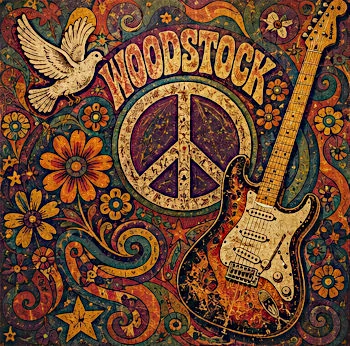
What people remember about Woodstock isn't just the music, extraordinary as it was. It's the feeling — captured in photographs of strangers sharing food, dancing together in the rain, and looking out for one another across three days with almost no formal structure to rely on. Max Yasgur's own words from the stage still capture it best: half a million young people gathered in one place, and proved that a generation could come together in peace, for nothing more than music and each other's company.
That's the story worth telling about Woodstock. Not a festival that succeeded despite the odds, but one that became unforgettable because of how the people there rose to meet them — turning a farm in Bethel, New York, into the site of one of the greatest weekends in the history of live music.
This article was inspired by my good friend Lis - thanks Lis dear!
ARTICLE CATEGORY
Music