Tarot cards have fascinated people for centuries, offering insight into the future, guidance in decision-making, and a deeper understanding of oneself. Rooted in symbolism and intuition, tarot has evolved from a 15th-century card game into one of the most widely used tools for divination and personal exploration in the world. This guide covers the history, structure, and meaning of tarot cards, how a reading actually works, and why tarot continues to resonate with both spiritual seekers and skeptics alike.
The origins of tarot cards can be traced back to the 15th century in Europe, where they were first used purely as playing cards for a game called tarocchi in Italy. The earliest known tarot deck, the Visconti-Sforza deck, was commissioned by the Duke of Milan around the 1440s and remains one of the most beautifully preserved examples of early tarot art.
It wasn't until the late 18th century that tarot began to be associated with mysticism and divination rather than gameplay. The shift was largely driven by French occultists and scholars, most notably Antoine Court de Gébelin, who claimed — without historical evidence — that tarot cards contained ancient Egyptian wisdom smuggled into Europe. Though modern historians have thoroughly debunked this theory, it marked the beginning of tarot's transformation into a spiritual and esoteric practice, one that continued through the 19th-century occult revival led by figures like Éliphas Lévi and, later, the creators of the influential Rider-Waite-Smith deck in 1909.
A standard tarot deck consists of 78 cards, divided into two main categories: the Major Arcana and the Minor Arcana. Together, these two sets of cards are designed to represent the full range of human experience, from major life turning points to the small day-to-day details of relationships, work, and emotion.
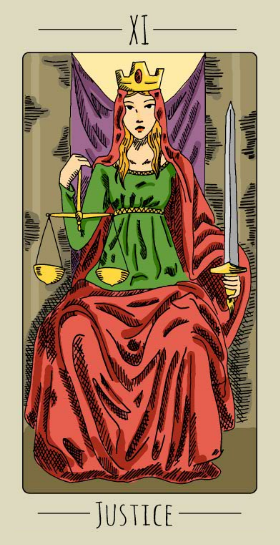
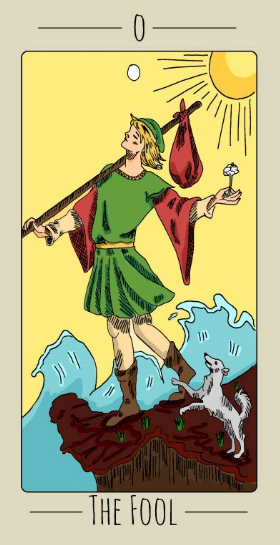
Comprising 22 cards, the Major Arcana represents significant life events, spiritual lessons, and deep psychological themes. Each card, from The Fool (0) to The World (21), tells part of a larger story — often called "the Fool's Journey" — that symbolizes a path of growth from innocence and new beginnings through challenge, transformation, and ultimately fulfillment. Cards like The Tower, Death, and The Wheel of Fortune tend to carry the most weight in a reading, since they typically point to major turning points rather than everyday circumstances.
The Minor Arcana consists of 56 cards divided into four suits: Wands, Cups, Swords, and Pentacles. Each suit represents a different aspect of everyday life, similar to how a standard deck of playing cards is divided into hearts, clubs, diamonds, and spades:
Each suit runs from Ace through Ten, followed by four court cards — typically the Page, Knight, Queen, and King — which often represent personality traits, roles, or specific people relevant to a reading.
During a tarot reading, the reader shuffles the deck while focusing on a question or area of life, then lays out a specific number of cards in a pattern known as a spread. Each position in the spread carries its own meaning, and the reader interprets the cards drawn based on their symbolism, orientation, and relationship to the surrounding cards.
There are countless spreads used in tarot readings, ranging from a simple one-card daily draw or a three-card spread representing past, present, and future, to more complex layouts like the ten-card Celtic Cross, which offers a deeper analysis of a specific situation, its underlying influences, and its likely outcome. Beginners often start with smaller spreads before working up to more intricate ones as they become familiar with card meanings.
Tarot reading is as much an art as it is a system of fixed meanings. While each card has traditional associations built up over centuries of practice, interpretation relies heavily on the reader's intuition and the specific context of the question being asked. Many readers also draw on their own insight, life experience, and knowledge of the person they're reading for to provide more personalized, nuanced guidance rather than a rigid, one-size-fits-all interpretation.
Reversed cards — those that appear upside down in a spread — add another layer of interpretation for many readers, often suggesting a blocked, delayed, or internalized version of the card's usual meaning.
In contemporary times, tarot has found a place not only in spiritual and divinatory practice but also in personal development, journaling, and therapy-adjacent self-reflection. Many people use tarot as a structured way to explore their subconscious, confront personal challenges, and build self-awareness, treating the cards less as fortune-telling and more as a prompt for honest introspection.
Tarot cards encourage reflection and can help clarify thoughts and feelings around difficult decisions. Whether used for guidance in relationships, career choices, creative work, or personal growth, tarot serves as a kind of mirror — one that reflects back whatever the querent brings to the reading, much like witchcraft and other divination practices such as astrology or scrying are often used alongside it.
Tarot cards are more than a tool for fortune-telling; they are a rich tapestry of history, symbolism, and psychological insight built up over more than five centuries. Whether you approach tarot with skepticism or an open heart, the cards have the potential to offer perspective, clarity, and a deeper understanding of life's complexities.
If you're curious about tarot, consider exploring a beginner-friendly deck like the Rider-Waite-Smith and learning the meanings of the cards a few at a time rather than all at once. Remember that each reading is a journey into your own psyche — a chance to uncover truths and foster personal growth, not a guaranteed prediction of the future. With a mix of tradition and intuition, tarot invites you to embrace the mysteries of life and your own potential.
ARTICLE CATEGORY The Occult
Tarot card images by vecteezy.com